


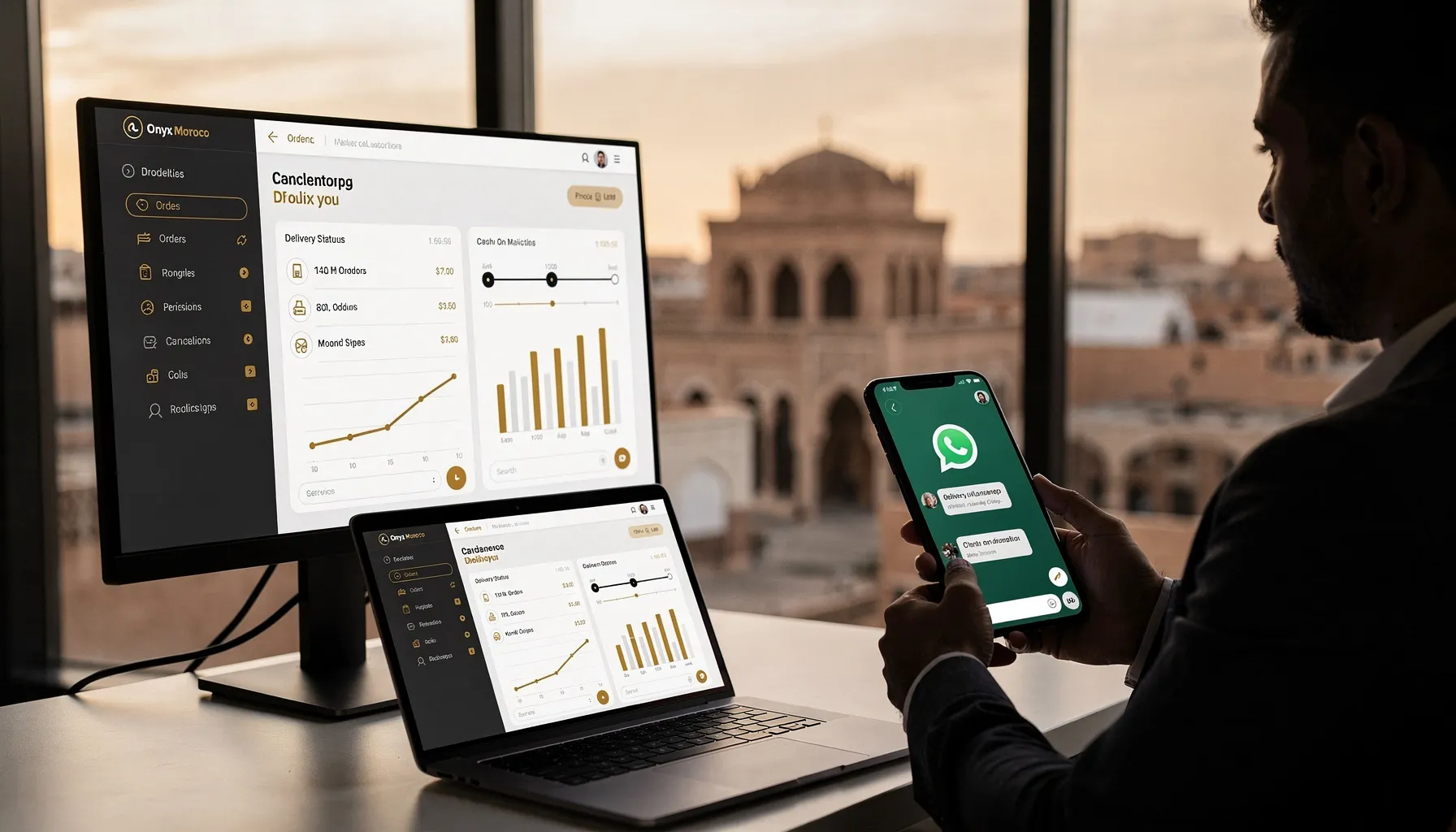
The Moroccan e-commerce landscape has a paradox at its core: cash-on-delivery dominates as the preferred payment method, yet it bleeds merchants through cancellation rates that routinely exceed 25%. For every ten orders confirmed through social commerce channels, two or three never complete their journey to the customer’s doorstep. The cost is not just logistical—it erodes margins, distorts inventory planning, and undermines the business case for scaling. But a growing cohort of Moroccan operators, backed by local UX specialists and WhatsApp automation partners, is proving that sub-15% COD cancellation is not aspirational. It is operational. The formula hinges on three interlocking pillars: a WhatsApp-first communication architecture, a ruthlessly simplified single-page checkout, and micro-segmentation by city that aligns pricing, expectations, and verification intensity with on-the-ground realities.
Key Takeaways
- A single-page, mobile-first checkout with only four essential fields—name, phone, city/neighborhood, and address details—is the baseline for reducing Moroccan COD cancellations.
- WhatsApp double confirmation (at order placement and evening before dispatch), combined with per-city delivery fees displayed upfront, eliminates the “surprise at the door” refusals that drive most COD losses.
- Micro-segmentation by city enables differentiated delivery ETAs, risk-based verification rules, and localized messaging—turning COD from a uniform liability into a controllable, data-informed process.
- Compliance with Law 09-08 and WhatsApp Business API opt-in rules is non-negotiable; transactional messaging costs roughly 0.35 MAD per conversation, with the first 1,000 free each month.
The COD Burden, by the Numbers
Morocco’s e-commerce payment behavior is shaped by deep structural factors: limited banking penetration outside major urban centers, lingering distrust of online card payments, and a social commerce ecosystem built on Instagram and Facebook storefronts where the handshake happens in DMs. COD is not a convenience—it is the default rail. Yet it carries an inherent fragility that multi-step checkouts amplify. Buyers abandon forms. They mistype phone numbers. They reach delivery day unaware of the total amount due, and they refuse parcels.
According to Casablanca-based UX consultancy Sentinel Studio, a well-designed COD checkout for the Moroccan market in 2026 should target three benchmarks: checkout completion rate above 65%, COD cancellation rate below 20%, and a fake phone number rate under 5%. Hitting sub-15% cancellation—the threshold where unit economics genuinely shift—demands redesigning the upstream flow, not just chasing down orders after they are placed.
The same research identifies the primary friction points: multi-step checkouts collapsing on 6-inch screens, mandatory email fields that Moroccan mobile shoppers actively resist, and free-text address entry that generates unusable delivery data. These are not cosmetic issues. They are directly correlated to cancellation volume.
Anatomy of a Single-Page Checkout That Actually Converts
The single-page checkout is not a design trend. In the Moroccan context, it is a survival mechanism. “A 4-step checkout on a 6-inch screen is massive friction,” Sentinel Studio’s guidance states bluntly. Every additional screen introduces a decision point where the buyer can abandon, mistype, or lose confidence in what they are ordering and what they will pay.
Only four fields should be mandatory: name, phone number, city/neighborhood, and delivery address details. Email must be optional. The majority of Moroccan COD shoppers will not enter an email address—forcing it kills orders. Email addresses can be recovered later through WhatsApp if needed for invoicing or remarketing.
Address capture requires particular discipline. A single free-text field invites chaos: misspelled city names, missing neighborhoods, and delivery addresses couriers cannot locate. The answer is structured fields with autocomplete—city first, then neighborhood, then a “details” field for building numbers and landmarks. This structure feeds directly into the micro-segmentation engine that governs delivery fees, ETAs, and risk rules downstream.
Several mobile-specific UX decisions have outsized impact on COD outcomes: buttons at least 48px high for comfortable tap targets, automatic numeric keyboards on phone fields to minimize typos, wide single-column input layouts, a collapsible order summary to avoid screen overload, and a sticky “Confirm Order” button permanently anchored at the bottom. These are not polish—they determine whether the order data that reaches the back office is clean enough to deliver.
| Checkout Element | Standard Moroccan E-Commerce | Optimized COD Single-Page |
|---|---|---|
| Number of steps | 3–4 screens | 1 screen |
| Mandatory fields | 6–8 (incl. email) | 4 (email optional) |
| Address format | Single free-text line | City + neighborhood + details with autocomplete |
| Order summary visibility | Separate screen | Collapsible, same screen |
| Tap targets | Variable, often sub-48px | Minimum 48px height |
| Confirmation button | May require scrolling | Sticky, always visible |
| Target completion rate | ~45–55% | >65% |
Immediately after order confirmation, buyers need a success page that eliminates ambiguity: order summary, total COD amount including delivery fee, and an estimated delivery time. An automatic SMS with the order number should fire instantly. And critically, an automated WhatsApp message—powered by the WhatsApp Business API—should land in the customer’s chat within seconds, restating what they ordered, what they will pay, and when it will arrive. This immediate, multi-channel confirmation is the first line of defense against post-checkout anxiety and the “I changed my mind” cancellations that follow.
WhatsApp-First: From Order Confirmation to Delivery Assurance
WhatsApp is not a marketing channel in Morocco—it is the communication layer on which daily life operates. Moroccans use it for personal chat, voice notes, customer service inquiries, and increasingly, commercial transactions. For an e-commerce operator, WhatsApp-first means treating the messaging platform as the central nervous system of the COD flow: acquisition, confirmation, verification, and post-delivery follow-up all run through the same thread.
The operational mechanics rest on the WhatsApp Business API, which can be accessed either directly through Meta’s Cloud API or via local integrators such as Wasel, Botsfabrik, Clarodigi, or CashOD. The economics are favorable: service conversations initiated by customers cost approximately 0.35 MAD per conversation, with the first 1,000 service conversations per month free. Meta’s Cloud API is free to set up, requiring a verified business with a dedicated phone number and legal documentation including RC, IF, and ICE. Verification typically takes three to seven business days.
The Double Confirmation Protocol
The single most impactful WhatsApp tactic for COD cancellation reduction is the double confirmation. As Scaanme’s WhatsApp commerce guide for the Maghreb advises: “Confirm the order twice in the chat: once when it arrives, once the evening before dispatch. Unconfirmed parcels come back.” The first confirmation is automated and immediate—triggered by the checkout completion. The second is sent the evening before the parcel leaves for delivery, giving the buyer a final opportunity to confirm, modify, or cancel before logistics costs are sunk.
For high-ticket orders—those exceeding 500 MAD—or for first-time customers, the protocol escalates. WhatsApp confirmation is supplemented by a phone call. This hybrid approach filters out opportunistic or fraudulent orders that slip past digital verification. It also signals to genuine buyers that the merchant is serious about delivery, reinforcing trust.
Language, Tone, and Timing
WhatsApp messages for Moroccan COD flows must respect the platform’s cultural norms. Darija (Moroccan Arabic) is preferred over formal Arabic or French for mass-market audiences—it signals familiarity and reduces the psychological distance between merchant and buyer. Bilingual catalogs combining French and Arabic serve audiences across different literacy and preference groups. Messages must be short, clear, and actionable; WhatsApp is personal space, and verbose corporate language triggers dismissal.
Timing matters acutely. Messages should be sent between 9 AM and 9 PM. Late-night confirmations annoy customers and generate negative sentiment that can feed into WhatsApp’s quality score system, risking message throttling or number bans. Promotional messages perform best in windows of 10 AM–12 PM and 7 PM–9 PM, with adjustments during Ramadan when peak activity shifts to post-iftar hours.
Micro-Segmentation by City: The Operational Unlock
Morocco is not a uniform delivery market. Courier coverage, reliability, transit times, and customer expectations vary sharply between Casablanca, Marrakech, Tangier, Fes, and smaller cities. Treating delivery as a flat national service—same fee, same ETA, same verification rules—is a recipe for cancellations. WhatsApp-commerce guides for the region now recommend treating delivery fees and ETAs “per city” as standard practice, not an edge case.
City-Specific Fees and ETAs, Displayed Upfront
The checkout page must surface the delivery fee for the buyer’s city before they confirm the order. If a customer in Agadir sees a 35 MAD delivery charge only at the door, refusal is probable. If that same fee is visible on the checkout page and reiterated in the WhatsApp confirmation, the expectation is set. The same principle applies to delivery time: a Casablanca intra-city order might arrive in 24–48 hours, while a Casablanca-to-Oujda shipment requires three to five days. Stating this explicitly eliminates the “I didn’t know it would take that long” cancellation category.
Risk-Based Verification by City Segment
Beyond pricing and ETAs, city-level segmentation enables differentiated verification intensity. Merchants who track cancellation rates by delivery zone can identify cities and neighborhoods with disproportionately high refusal rates. For those segments, stricter rules apply: mandatory WhatsApp double confirmation, additional phone verification, and potentially pre-payment or deposit requirements for high-value orders. Low-risk urban corridors with established courier networks can run lighter flows, minimizing friction where it is not needed.
This is the strategic leap: COD stops being a binary, one-size-fits-all payment method and becomes a portfolio of city-tuned workflows, each with its own pricing, communication cadence, and risk controls. The checkout data—structured city and neighborhood fields—feeds directly into this segmentation engine.
Compliance Is Not Optional
WhatsApp automation in Morocco sits at the intersection of two regulatory frameworks: Meta’s platform policies (opt-in requirements, template approval, quality scores) and Moroccan Data Protection Law 09-08, which mandates explicit consent for personal data processing and marketing communications. This dual compliance requirement is not bureaucratic overhead—it is existential. Using unapproved bulk-sending tools or sending messages without opt-in risks permanent WhatsApp number bans that can shutter a merchant’s entire communication infrastructure overnight.
As Wasel’s compliance guidance states bluntly: “Opt-in is the explicit consent of a contact to receive your messages. Without opt-in, every message you send is technically spam.” The opt-in mechanism should be integrated into the checkout flow itself—a simple checkbox consenting to WhatsApp updates and order communications. For the COD use case, transactional messages (order confirmations, delivery updates) occupy a safer regulatory zone, but collecting opt-in at checkout future-proofs the channel for marketing and retention messaging.
The broader Moroccan digital ecosystem is maturing rapidly around these compliance questions. Events like GITEX Africa 2026 in Marrakech have placed digital sovereignty and data governance at the center of the national tech conversation, signaling that regulatory scrutiny will only intensify. Merchants who build compliant WhatsApp flows now will avoid costly remediation later.
The Integrated Flow: Putting the Three Pillars Together
When WhatsApp-first, single-page checkout, and city micro-segmentation operate as a unified system, the end-to-end COD flow looks fundamentally different from the fragmented processes that produce 25%+ cancellation rates:
Discovery and Acquisition. Traffic arrives via Instagram, Facebook, or WhatsApp catalog links. A floating WhatsApp button is visible on every page, inviting instant chat—this alone reduces the gap between browsing and trust-building.
Single-Page Checkout. The buyer sees four fields, city autocomplete, a visible delivery fee for their location, and a sticky confirmation button. No email gate. No multi-screen friction. The order summary and total COD amount are visible on the same screen.
Immediate Multi-Channel Confirmation. The success page displays the order summary, total amount, and city-specific ETA. An SMS and a WhatsApp message fire simultaneously—both in Darija, both restating the COD amount and delivery window.
Back-Office Segmentation. The system assigns the order to a city segment with pre-configured rules: fee and ETA parameters, plus a risk profile that determines verification intensity. High-risk city-order combinations trigger human review and a phone call.
Pre-Dispatch WhatsApp Touchpoint. The evening before dispatch, a second WhatsApp message lands: city-specific ETA, COD amount reminder, and a simple “confirm or modify” prompt. Unconfirmed parcels are held.
Delivery Day and Post-Delivery. An optional WhatsApp message with courier tracking reference and approximate arrival window. After delivery, a satisfaction check-in and an opt-in invitation for future promotions if not already collected.
The Debate: Optimize COD or Push Digital Payments?
An undercurrent of tension runs through Moroccan e-commerce circles: should merchants invest heavily in COD optimization, or should they accelerate the transition to card payments and digital wallets? The answer is not either/or—it is sequencing. For the vast majority of Moroccan online buyers, particularly outside the Casablanca-Rabat corridor, COD remains the only psychologically acceptable payment method. Building a checkout that treats COD as a second-class citizen—buried behind card prompts, lacking clear fee disclosure, communicating only via email—is a strategy for losing market share today in pursuit of a payment behavior shift that will take years.
The operators achieving sub-15% cancellation rates are not abandoning digital payments. They are designing COD flows so efficient that they generate the trust, data quality, and customer relationships that make digital payment adoption organic. A buyer who has completed three successful COD transactions with clear communication and on-time delivery is far more likely to pay online on the fourth order. The WhatsApp thread that began as a COD confirmation channel becomes a relationship layer where prepayment offers can be extended credibly.
What Sub-15% Looks Like in Practice
The 15% threshold is not a theoretical ceiling—it is an operational target that combines measurable improvements across checkout completion, address accuracy, confirmation response rates, and delivery-day refusals. Merchants who deploy the full stack can expect:
- Checkout completion rates climbing from the 45–55% range past 65%, driven by single-page simplification and email optionality.
- Fake or unreachable phone numbers dropping below 5%, supported by automatic numeric keyboards and WhatsApp-based verification.
- Evening-before-dispatch confirmations converting at high rates, flagging the genuinely disinterested before logistics costs are incurred.
- City-level fee transparency eliminating “surprise” refusals, which typically account for a third or more of all COD cancellations.
The tools exist. The WhatsApp Business API is accessible and affordable. Local integrators—from Botsfabrik for CRM-connected automation to Scaanme for storefront-to-delivery WhatsApp workflows—have built Morocco-specific solutions that abstract away the technical complexity. The regulatory pathway is clear: collect opt-in, use approved templates, monitor quality scores. What remains is the operational discipline to treat COD not as an unavoidable cost of doing business in Morocco, but as a controllable process that rewards precision in design, communication, and segmentation.
For Moroccan founders and growth teams, the message is unambiguous. The difference between 25% and 12% COD cancellation is not a better product or a bigger marketing budget. It is a checkout page with four fields instead of eight, a WhatsApp message sent the night before dispatch, and a delivery fee displayed before the order is placed. These changes are small. Their compounding effect on unit economics is not.



Discussion
Add your perspective.
A question, a different perspective or experience to share? Add to the conversation.