


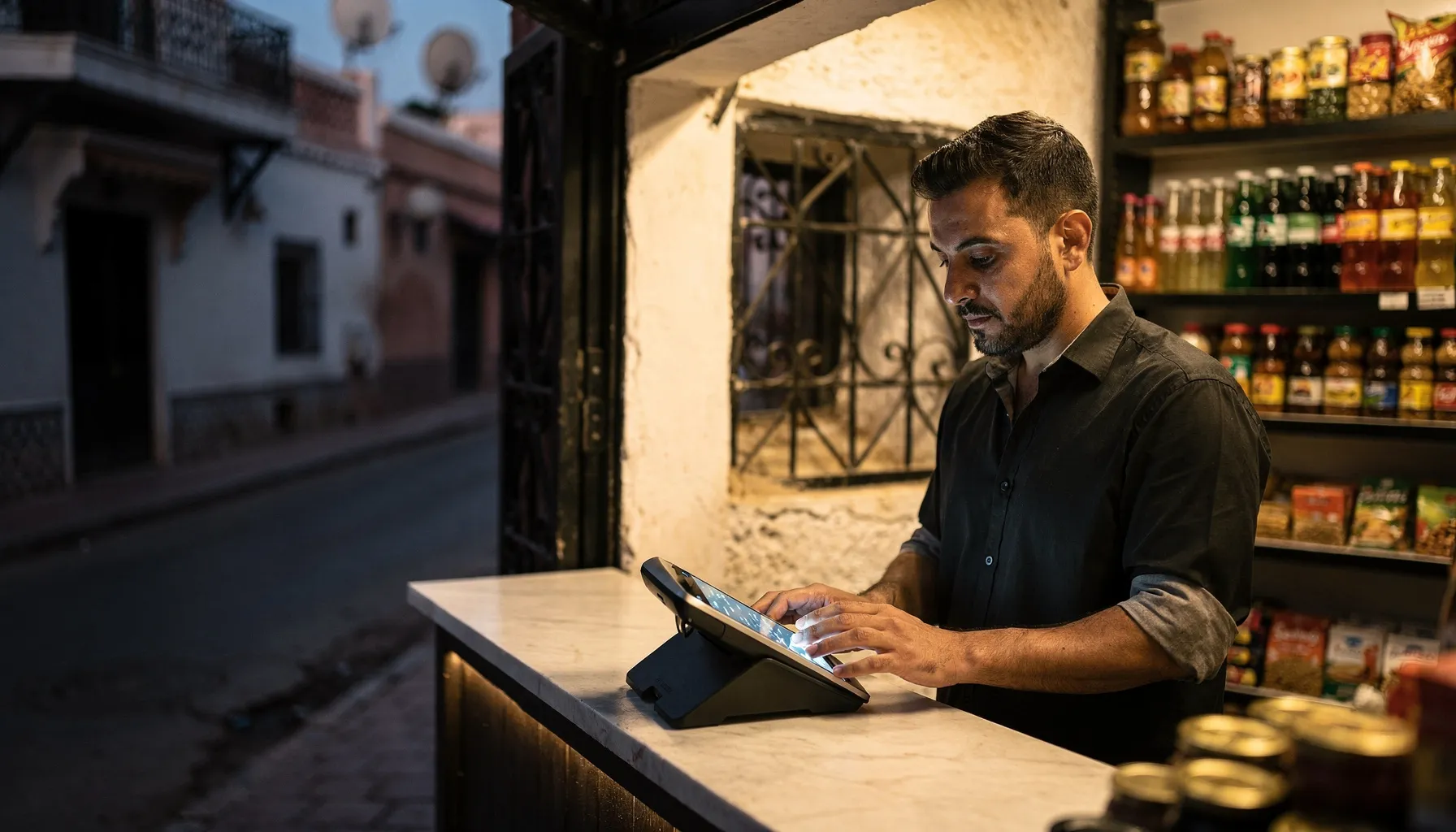
Morocco’s neighbourhood hanout—the small, family-run corner shop that anchors daily life in cities and villages alike—has long operated on cash, personal trust, and handwritten ledgers. That is now changing at speed. Under the Commerce 2030 roadmap, the Ministry of Industry and Trade (MIC) has signed a series of structured partnerships with Moroccan retail-tech and fintech startups to transform these informal micro-businesses into data-driven, digitally connected points of sale and financial access hubs. The ambition is not modest: connect 50,000 shops through a national digital distribution platform, deploy 20,000 smart payment terminals, and equip 100,000 proximity merchants with electronic payment solutions—all by the end of the decade.
Key Takeaways
- The Ministry of Industry and Trade has designated Z.Systems as the national digital intermediation platform for distribution, targeting 50,000 retailers by 2030, while Woliz will deploy 20,000 connected payment terminals and scale its Woliz Pro app to 90,000 merchants.
- A separate protocol with Chari, Al Barid Bank, and Barid Cash aims to equip 100,000 proximity merchants with electronic payment solutions and digital financial services, with the state subsidising early adopters.
- The Moroccan Retail Tech Builder (MRTB) has already supported 161 startups and plans to incubate 300 more between 2025 and 2027, creating a dedicated pipeline for commerce-focused innovation.
- For founders and SMEs, Commerce 2030 creates a state-backed distribution market with clear numerical targets, institutional partners, and reduced go-to-market friction in payments, lending, logistics, and merchant SaaS.
- Physical-goods e-commerce in Morocco currently represents only 0.5% of GDP; the government targets 10 billion MAD by 2025 and 20 billion MAD by 2030, with digitised hanouts serving as last-mile pickup points and micro-fulfilment nodes.
The Commerce 2030 Vision
The digitalisation of internal trade sits among the fundamental axes of Morocco’s sector plan for commerce. The Ministry has framed Commerce 2030 around three interconnected priorities: financial inclusion, digital integration, and the modernisation of wholesale markets and supply chains. Rather than acting solely as a regulator, the Ministry is positioning itself as an active market-maker—signing formal conventions with startups that can supply distribution software, payment infrastructure, and merchant management tools at scale.
The Moroccan Retail Tech Builder (MRTB), launched in partnership with Mohammed VI Polytechnic University and the OCP Foundation, is the Ministry’s incubation and acceleration channel for this transition. It is described as the first platform in Morocco dedicated exclusively to digital startups in commerce. According to the Ministry, MRTB has already supported 161 startups, and a second phase running from 2025 to 2027 targets 300 additional ventures. The programme has also numerically integrated 4,500 small merchants via digital platforms and created 200 delivery points hosted in proximity shops for e-commerce fulfilment.
These numbers sit within a broader national e-commerce ambition. Physical-goods e-commerce in Morocco currently accounts for roughly 0.5% of GDP, compared with a global average near 5%. The government’s targets—10 billion MAD by 2025 and 20 billion MAD by 2030—require building the last-mile infrastructure that only a dense network of neighbourhood shops can provide.
The Startup Partnerships Driving the Shift
The Commerce 2030 rollout rests on a series of formal agreements between the Ministry, financial institutions, and Moroccan retail-tech startups. Each partnership targets a distinct layer of the hanout digitisation stack.
Z.Systems: The National Distribution Layer
Z.Systems has been designated as the national digital intermediation platform for distribution, with a mandate to digitally connect 50,000 retailers by 2030. The platform goes beyond a simple ordering catalogue: it offers shopkeepers direct access to major brands and distributors—bypassing fragmented intermediaries—alongside integrated loyalty programmes and secured e-wallets for dematerialised payments. Minister Ryad Mezzour has publicly named Z.Systems among ten Moroccan startups receiving reinforced support from the Ministry.
For hanouts, this means ordering and replenishment become digital and traceable, generating structured data on SKUs, volumes, and margins. For founders, Z.Systems effectively functions as a B2B2C data layer over tens of thousands of shops, opening opportunities in trade credit scoring, targeted FMCG promotions, and optimised route-to-market logistics.
Woliz: Smart Terminals and the Merchant Operating System
A second major convention targets the startup Woliz, which will deploy 20,000 connected payment terminals in its first phase and scale its Woliz Pro application to 90,000 merchants nationwide. Woliz Pro bundles digital payment acceptance with management tools covering cash handling, inventory, and transaction tracking. The startup has also formed payment partnerships with Attijari Payment and Visa, signalling a move toward broad card and digital-payment interoperability. In January 2026, Woliz raised $2.2 million to accelerate its neighbourhood retail digitisation efforts.
The implications extend well beyond payments. Transaction-level data—amount, time, payer, payment method—becomes available for revenue analytics, creditworthiness assessment, and structured tax reporting. For fintech startups, Woliz’s network functions as a distribution rail for lending, insurance, and B2B services that can integrate via APIs into merchant terminals.
Chari, Al Barid Bank, and Barid Cash: Payments at Scale
At the Forum National du Commerce in Marrakech, the Ministry signed a protocol with Al Barid Bank, Barid Cash, and startup Chari to equip 100,000 proximity merchants with electronic payment solutions and digital financial services. The agreement explicitly targets Visa and Mastercard card acceptance, wallet integration, and broader financial ecosystem participation. The State has committed to supporting the first 100,000 merchants who adopt these solutions.
Notably, Minister Mezzour stated that collaboration with Al Barid Bank and Chari has already reduced electronic payment costs from 1.7% to 0.8%—a material improvement in unit economics for both small merchants and the fintech providers serving them. For founders, this creates a subsidised onboarding funnel and a clearer business case for low-margin payment products that can cross-sell higher-margin services such as lending and insurance.
WafR: Hanouts as Financial Access Hubs
Startup WafR explicitly positions hanout shops as points of access to financial and digital services, transforming them into local financial hubs. Its platform uses proximity shops as distribution points for digital and financial services—likely including mobile top-ups, bill payments, vouchers, and micro-remittances. This model generates commission-based revenue streams for shopkeepers while producing rich transactional data on financial behaviour at the micro-local level. For fintech founders, it demonstrates how hanouts can function as a dense, trust-based agent network without the cost of building physical branches.
MRTB and the Banking Backbone
Beyond individual startup partnerships, the Ministry has built institutional scaffolding. A tripartite agreement between MIC, BCP Group, and payment institution M2T aims to promote commerce digitalisation and financial inclusion while accompanying MRTB startups. The partnership gives retail-tech ventures access to regulated payment rails, risk and compliance expertise, and co-designed pilots with major financial institutions—reducing the go-to-market friction that typically slows fintech innovation.
From Cash-Only Corner Shop to Data-Driven Micro-Enterprise
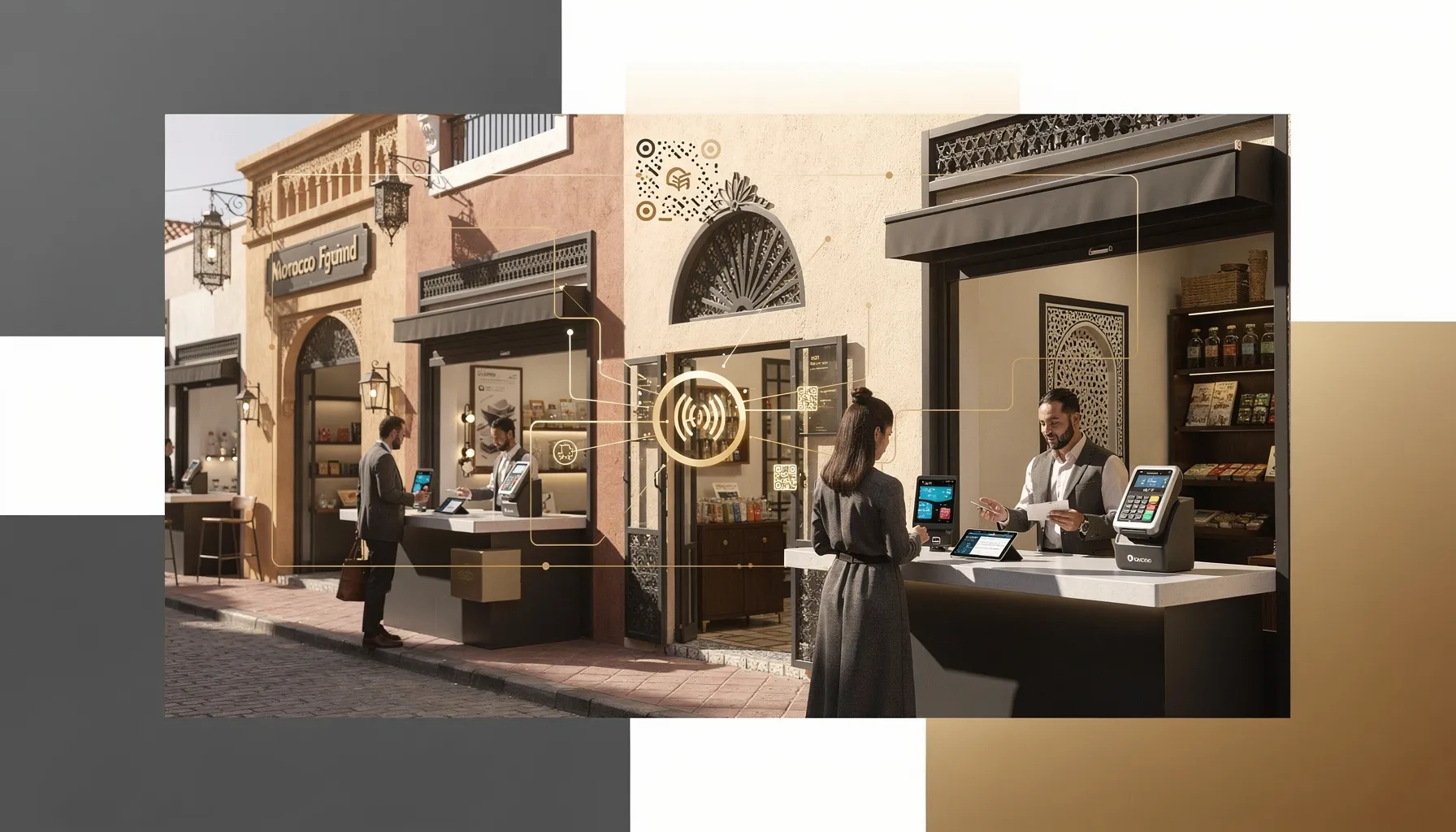
The convergence of these programmes is reshaping what a typical hanout looks like operationally. Several changes are unfolding simultaneously.
Digital transaction recording. E-wallets, card acceptance, and smartphone-based Tap to Mobile solutions—which allow merchants to accept card payments via NFC-enabled Android phones without dedicated POS hardware—are replacing cash-only operations. This generates structured transaction data that can be analysed for turnover patterns, peak hours, customer segments, and cashflow cycles.
Inventory and order management. Platforms like Z.Systems digitise ordering from major brands and distributors, while Woliz-connected terminals enable real-time inventory updates and stock alerts. Shopkeepers who once relied on memory and paper notes now have tools to track what sells, when, and at what margin.
Customer and loyalty data. Loyalty programmes embedded in these platforms create unique customer identifiers and track redemption behaviour at the product and store level—data that was previously invisible in informal retail.
Financial integration. Partnerships with banks and payment institutions give hanouts access to wallets, merchant accounts, and formal financial products, tying them into the national financial system for the first time.
The cumulative effect is that a typical hanout is becoming a data-producing micro-enterprise with digitally recorded sales and purchases, traceable customer interactions, and interfaces to formal finance. Modernisation programmes complement this with equipment upgrades, working capital support to strengthen liquidity, and digital training for small merchants.
What This Unlocks for Moroccan Founders and SMEs
Commerce 2030 is not merely a digitisation programme—it is a state-backed distribution market with defined numerical targets and institutional partners. For Moroccan founders, developers, and SMEs, this creates several structural advantages.
Predictable demand. Clear targets—50,000 shops via Z.Systems, 20,000 terminals and 90,000 merchants via Woliz, 100,000 merchants for e-payments via Chari and Al Barid Bank—create foreseeable demand for enabling technologies and complementary services. Startups can build with confidence that a distribution channel exists.
Reduced go-to-market friction. MIC, BCP, Al Barid Bank, and M2T act as distribution partners, helping startups reach merchants at scale. MRTB and dedicated incubators provide institutional backing, mentorship, and access to regulated payment rails that would otherwise take years to negotiate independently.
The product opportunity map spans several layers:
- Merchant OS and vertical SaaS. Advanced inventory, pricing, staff management, and analytics tools that sit atop existing terminal infrastructure. Sector-specific solutions for pharmacies, hardware stores, and food retail integrated into the Commerce 2030 ecosystem.
- Embedded fintech. Working capital lending and dynamic credit limits based on real sales data. BNPL for end-customers routed through hanouts, backed by behavioural data from loyalty and payment systems. Micro-insurance and savings products distributed through shop networks.
- Logistics and last mile. Route optimisation and shared delivery fleets for hanout orders. Micro-fulfilment solutions where digitised shops act as urban warehouses for e-commerce parcels.
- Data and analytics platforms. Dashboards for ministries and banks to monitor digitisation KPIs. FMCG intelligence platforms aggregating anonymised shop data for brands and distributors.
For SMEs that supply merchants—FMCG companies, wholesalers, logistics providers—digitisation unlocks better visibility on downstream sell-out, the ability to run digital trade marketing campaigns at the individual hanout level, and lower costs of servicing small accounts through automated ordering and invoicing.
The Emerging Data Infrastructure
Perhaps the most consequential dimension of Commerce 2030 is the data layer it is constructing. Once tens of thousands of hanouts are digitised, three categories of data become available at scale: merchant-level data (turnover, product mix, seasonality, payment methods), customer-level data (footfall, basket size, loyalty status, promotion response), and territorial data (consumption patterns by district, region, and socio-economic cluster).
This data infrastructure can be leveraged for credit scoring and SME finance—using sales and payment histories to build alternative credit models for merchants and their customers. It can power FMCG and retail analytics, enabling brands to tune SKUs, pricing, and promotions based on actual micro-market behaviour. It can also inform urban planning and public policy by revealing consumption and financial inclusion gaps at the neighbourhood level.
For founders, Commerce 2030 is effectively building a national data infrastructure at the shop level, with ministries and banks acting as sponsors. The startups that build interoperable, API-first architectures capable of plugging into multiple state-backed platforms will be best positioned to capture value across this emerging stack.
Risks, Limitations, and What Could Go Wrong
For all its ambition, Commerce 2030 faces significant execution challenges that founders, investors, and policymakers should watch closely.
Adoption and skills gaps. While programmes include digital training and equipment modernisation, many hanout operators lack digital literacy and confidence with apps and POS systems. Merchant heterogeneity—differences in age, education, shop size, and urban versus rural location—could produce uneven adoption that leaves large segments of the target population untouched.
Platform fragmentation. Multiple platforms—Z.Systems, Woliz Pro, Chari, WafR, M2T technologies, Tap to Mobile—risk creating a fragmented tech stack at the shop level. Without interoperable standards and open APIs, data becomes siloed and merchants face the complexity of juggling several applications for ordering, payments, loyalty, and financial services.
Business model sustainability. Lowered payment fees from 1.7% to 0.8% benefit merchants but compress margins for payment service providers and fintechs. Heavy reliance on state support for the first 100,000 merchants raises the question of what happens when subsidies end and whether shopkeepers will pay full price for services they have grown accustomed to receiving at reduced cost.
Formalisation tension. Digitalisation and traceability help combat informality and support tax collection—but some hanout operators may view increased visibility to tax authorities and compliance burdens as a threat rather than a benefit. Founders must balance genuine value addition—credit access, better tools, new revenue streams—with the perceived risk that digitisation represents for merchants operating partially outside formal structures.
The e-commerce execution gap. With physical-goods e-commerce still at 0.5% of GDP and targets of 10 to 20 billion MAD by 2030, there is a substantial distance between current reality and stated ambition. Digitising hanouts as delivery and pickup nodes is necessary but not sufficient; consumer trust, logistics reliability, and product availability must scale in parallel.
What to Watch Next
Commerce 2030 is still predominantly at the announcement-and-partnership stage. The hardest phase—conversion—lies ahead: getting tens of thousands of small merchants to actively use these tools every day, across diverse regions and shop profiles. Several indicators will signal whether the programme is delivering on its promise.
First, watch for audited progress updates from the Ministry or partner startups that confirm how many merchants are actively transacting on these platforms, not just registered. Second, monitor whether interoperability standards emerge—common merchant IDs, transaction formats, and APIs that prevent the fragmentation risk from materialising. Third, observe whether follow-on startup funding flows into the ecosystem; Woliz’s $2.2 million raise is an early signal, but broader investment activity will indicate whether founders and investors see durable value beyond the initial state-backed push.
For Moroccan tech professionals, entrepreneurs, and decision-makers, Commerce 2030 represents a rare alignment of policy ambition, institutional backing, and startup execution capacity. If it succeeds, it could become one of the largest retail digitisation programmes in North Africa—and a live case study in how to convert informal neighbourhood commerce into a data-rich, fintech-enabled engine of economic inclusion. If it stalls at the partnership stage, it will join a long list of ambitious digital transformation plans that produced impressive headlines but limited operational change. The next two to three years will be decisive.
Related reading: Agenz’s $5M Seed Round Highlights Morocco’s Tech Shift · How BNPL Fees Erode Moroccan E-commerce Margins · Scaling Moroccan SME Exports Through eTrade.ma · AI Startups Fuel Morocco’s Digital Economy



Discussion
Add your perspective.
A question, a different perspective or experience to share? Add to the conversation.