Moroccan teams entering 2026 rarely face a binary choice between buying a no-code tool and hiring developers. The more practical question is how to combine three distinct layers — visual no-code builders, internal tools platforms, and custom code — into a stack that ships quickly, stays affordable, and respects local constraints around budget, talent, language, and data residency. This analysis breaks down what each layer does well, where it breaks, and how startups, SMEs, corporates, and public institutions in Morocco can sequence them without rebuilding everything two years later.
Key Takeaways
- 2026 development guidance converges on a three-layer model: no-code visual builders, internal tools platforms, and custom code.
- No-code is fast for portals, dashboards, and simple workflows, but struggles with complex logic, high-volume workloads, and code export.
- Internal tools platforms such as Retool, Appsmith, Budibase, and ToolJet sit in the middle and connect directly to production databases and APIs.
- Custom development remains necessary for regulated logic, legacy integration, and performance-critical systems.
- Open-source, self-hosted options are the most cost-efficient starting point for Moroccan teams with limited budgets and data residency concerns.
- Governance — deciding which layer may touch production data — matters as much as tool selection.
The three-layer model shaping 2026 stacks
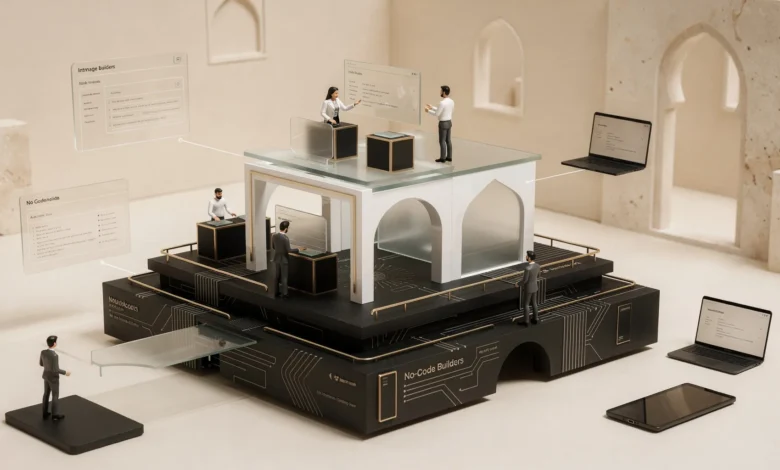
Recent 2026 guides on application development converge on a three-layer model: no-code visual builders, internal tools builders, and custom code. An enterprise-focused analysis groups internal tool platforms into developer-first low-code tools such as Retool, Appsmith, Budibase, ToolJet, and Superblocks; no-code visual builders for internal apps such as Softr, Glide, Noloco, JetAdmin, and Airtable Interfaces; and AI prompt-first generators such as Lovable and Bolt.new, according to this 2026 enterprise analysis.
The layering matters because each tier has a different failure mode. No-code collapses under complex conditional logic. Internal tools platforms depend on the quality of the database and API architecture underneath them. Custom code is powerful but slow and expensive to staff. A stack that mixes all three deliberately tends to outlast one built entirely inside a single tool.
No-code visual builders: where they fit
No-code visual builders let non-developers assemble apps and workflows through drag-and-drop interfaces, spreadsheets, or database views. The 2026 comparison landscape is crowded: Bubble, Glide, Softr, Stacker, Noloco, JetAdmin, and Airtable Interfaces cover web apps, client portals, and workflows, while Baserow and SeaTable specialise in no-code databases and internal apps with strong EU hosting and self-hosting options, as outlined in Baserow’s 2026 platform roundup.
For a Moroccan SME, that combination is often enough for sales pipelines, inventory tracking, a lightweight internal CRM, basic HR tools, and project tracking. Deployment is fast, and the people closest to the process can build the tool themselves rather than filing a ticket.
The limits are well documented. No-code platforms struggle with complex logic and performance at scale, and many restrict code export, which creates vendor lock-in. Governance and security depend heavily on the provider’s policies — a real consideration for teams handling customer data, as this European low-code and no-code review notes.
Internal tools platforms: the developer-adjacent middle layer
Internal tools builders sit between pure no-code and full custom development. They are designed for data-heavy internal systems: admin panels, operations dashboards, customer support tools, and back-end interfaces. 2026 reviews consistently place Retool as the dominant platform in this category, connecting directly to Postgres, MySQL, and MongoDB databases as well as APIs and SaaS tools, according to Stackby’s internal tools comparison.
Open-source and EU-friendly alternatives — Appsmith, Budibase, ToolJet, and WeWeb — offer self-hosting, which matters for teams weighing data sovereignty and long-term cost control. Some platforms now describe themselves as “code-optional,” offering no-code for most of the interface with the ability to inject custom code when needed, rather than starting entirely from scratch, as WeWeb’s selection guide explains.
The trade-offs are consistent across reviews. These platforms are far faster than building internal tools from scratch, and they fit well when engineers are available to wire data and logic. But developer-first low-code generally requires SQL or JavaScript, and per-seat pricing can escalate as more staff get access. Self-hosting open-source options reduces long-term cost and keeps data under the organisation’s control.
Custom development remains the backbone
Custom code remains essential in 2026 for complex business logic, high-scale systems, and performance-critical workloads. It is also the layer that handles deep integrations with legacy or on-premise software, and the workflows shaped by Moroccan-specific regulation.
Modern custom development typically combines a React or Next.js front end with a Node, Python, or Go back end, managed Postgres or MySQL databases, and APIs. AI code assistants such as Cursor, v0, Replit Agent, and Lovable are now part of the standard toolchain, accelerating scaffolding and repetitive work rather than replacing architectural decisions, according to this full platform comparison.
For fintech, healthtech, and logistics companies, this is where KYC/AML logic, payment workflows, and analytics live. As Morocco’s digital payments landscape evolves, integration work with local providers increasingly lands in this layer rather than in a no-code tool. The internal tools layer then sits on top of those systems instead of duplicating them.
How to combine the layers in practice
The 2026 guidance is consistent: start in no-code and progressively add internal tools and custom code as complexity grows, rather than committing to one approach from day one.
Database-centric architecture
Use a structured database — Postgres, MySQL, Baserow, or SeaTable — as the single source of truth for operations. Connect no-code tools and internal tools builders directly to that data, and let custom services validate and manipulate it. This avoids the fragmentation that appears when every team keeps its own spreadsheet.
API-first integration
Expose key business logic as APIs from the custom back end, then let internal tools such as Retool, Appsmith, or Budibase consume those APIs for admin interfaces. The internal tool becomes a view over governed logic rather than a second implementation of it.
Automation layer
Workflow tools such as n8n or Zapier connect SaaS services, internal tools, and custom systems. For Moroccan companies, this is often where local and global services meet: payment gateways, SMS providers, and cloud storage, as this automation guide describes.
AI-assisted development
AI builders such as Lovable, Bolt.new, or v0 can generate starter code and internal apps quickly, which engineers then refine. Treat the output as a draft, not a finished system. Choosing which model to build on is itself a decision — a question explored in Onyx’s guide to choosing the right AI model for Moroccan startups.
Choosing tools by team profile
Mostly non-technical teams
Operations, HR, finance, and support teams without developers should default to no-code visual builders — Glide, Softr, Stacker, Noloco, Airtable Interfaces, Baserow, or SeaTable — for portals, dashboards, and workflows. Keep logic simple and data volumes moderate, and use automation tools to connect email, WhatsApp, accounting, and support services.
One caution worth repeating: 2026 guides explicitly warn against trying to build internal tools in general-purpose no-code app builders such as Bubble. Multi-step financial workflows belong in a dedicated internal tools platform or in code, as this 2026 platform outlook argues.
Small development teams
Moroccan startups and SMEs with one to five engineers get the most leverage from developer-first internal tools platforms. Retool is the fastest route to internal dashboards on top of a production database; Appsmith or Budibase suit teams that prefer open source and self-hosting. Pair either with custom back-end code to enforce business rules, integrate local payment providers, and handle compliance.
Where possible, host data in EU-friendly or local environments — self-hosted Baserow, SeaTable, Appsmith, or Budibase — to align with emerging data residency expectations in Morocco and the region. The trade-off is real: more flexibility and scalability than pure no-code, but it requires SQL or JavaScript skills and per-seat costs that escalate at scale.
Large enterprises and public institutions
Banks, telecoms, logistics operators, and ministries have different constraints. Microsoft Power Apps and ServiceNow App Engine are highlighted in 2026 rankings for organisations already inside those ecosystems. Internal tools builders such as Retool, Appsmith, or Budibase handle advanced dashboards and admin systems, with self-hosting and strict access control where required. A strong custom development backbone remains necessary for core business logic, data warehouses, and regulatory compliance.
The practical benefit is a clear separation between citizen development in no-code and regulated systems built in code with restricted internal tools.
Costs, scalability, and governance
No-code tools typically offer free tiers and then scale per user or per workspace. Developer-first internal tools generally charge per seat for authenticated users, with enterprise plans on top. Open-source options — Appsmith, Budibase, Baserow, n8n — allow free self-hosting, with paid support or hosted versions available.
For Moroccan teams with limited budgets, the sensible sequence is to start with open-source, self-hosted options for internal tools and databases, and reserve paid cloud plans for external, mission-critical applications.
Scalability limits differ by layer. No-code tools reach their ceiling with very complex conditional logic, long transaction chains, high-volume low-latency workloads, and strict security requirements. Low-code and internal tools platforms scale further, but their performance depends on the underlying database and API architecture. Custom code scales furthest and costs the most to build and maintain.
Governance is the quieter issue. Every additional layer adds an access surface. Teams handling payments, health data, or citizen records should decide early which systems are allowed to touch production data and which are not — a discipline that connects directly to the pressures described in Onyx’s analysis of Morocco’s cybersecurity crisis.
What Moroccan teams should watch next
Three developments are worth tracking. First, data residency: the availability of EU-hosted and self-hosted no-code and internal tools options is changing what is feasible for regulated sectors, and it gives Moroccan organisations more room to keep sensitive data under their own control.
Second, AI-assisted development: as code assistants mature, the boundary between “no-code” and “custom” will keep shifting, and the cost of a first prototype will keep falling. That lowers the barrier for founders without a large engineering team, but it also raises the bar for reviewing what gets shipped.
Third, the local ecosystem. Cloud and IT integration events such as I3CIT 2026 shape which infrastructure options Moroccan teams can evaluate in person. Payment modernisation, described in Onyx’s coverage of Morocco’s digital payments shift, determines how much of the transaction layer must stay in custom code. And cybersecurity pressure decides how much can safely be delegated to third-party platforms at all.
The stack decision, in other words, is less about which tool wins in 2026 and more about which layer owns which responsibility — and how cleanly the three can be separated when the next requirement arrives.