


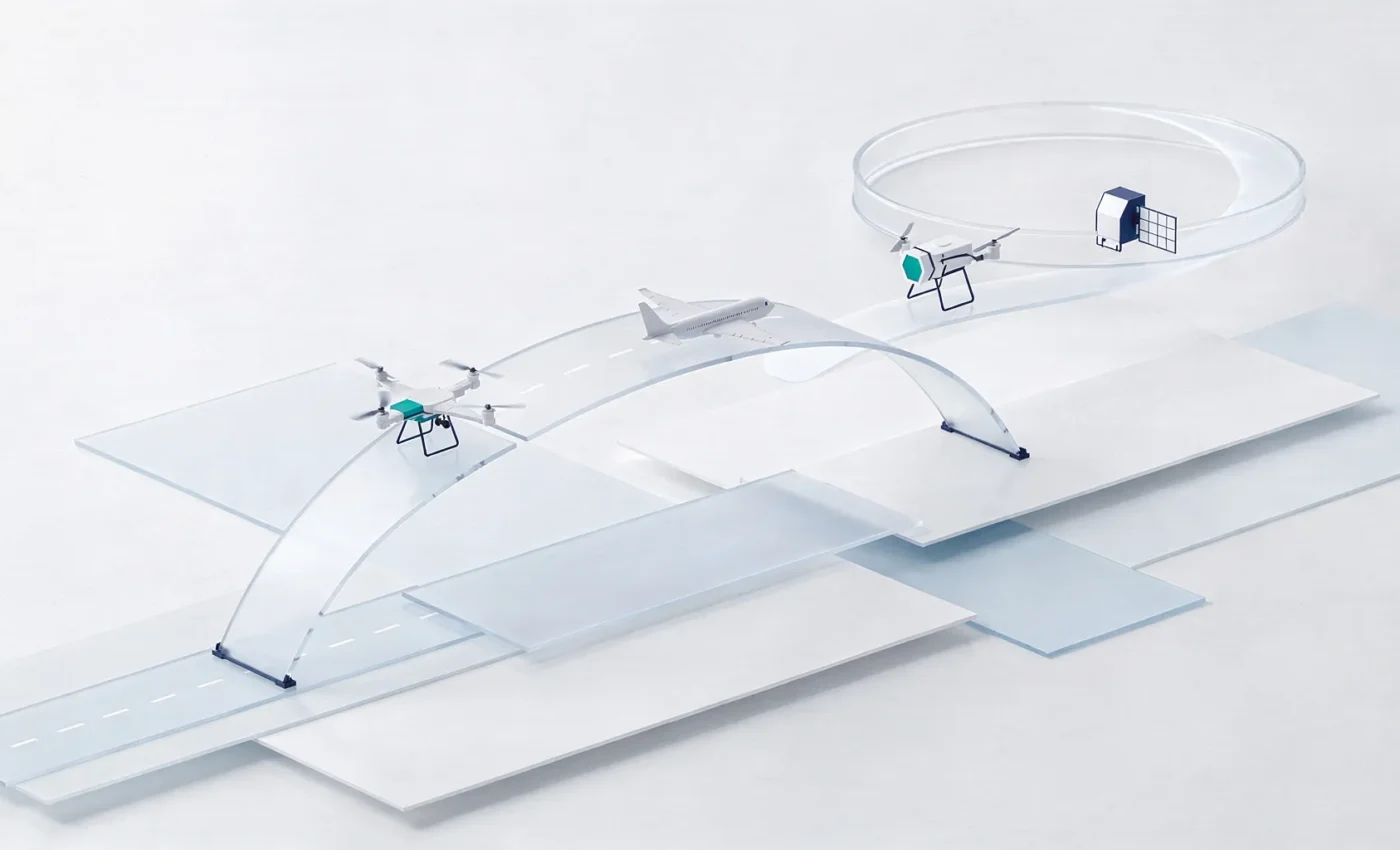
Morocco’s aerospace story is often told in aircraft parts. That base still matters, but the country is edging toward a systems-and-data economy in which drones, Earth observation, satellite communications, industrial autonomy and dual-use software sit alongside manufacturing. For local deep-tech founders, the opening is not to build a rival reconnaissance satellite or combat drone. It is to supply the software, electronics, testing, analytics and civilian applications that large contractors and public agencies need.
Key Takeaways
- Morocco’s aerospace cluster—roughly 160 companies and 25,000 workers—creates demand beyond assembly for engineering, quality, software and maintenance.
- Reports of a roughly $1 billion IAI satellite deal remain partly unconfirmed; the clearer opening is downstream data and software.
- Airbus and Safran anchor industrial needs that Moroccan startups can serve across sectors.
- The strongest strategy is civilian-first, multi-vendor and pilot-driven, with defense as a later vertical.
Morocco’s aerospace base is already wider than assembly
Around 160 Moroccan aerospace companies employ some 25,000 people and supply major manufacturers including Airbus, Boeing and Safran, according to industry figures cited by Reuters. Safran is expanding its Moroccan footprint in landing gear and engine work for Airbus, deepening demand for precision manufacturing, quality assurance, embedded systems and specialized engineering.
Industrial localization rarely stops at the final assembly line. Prime contractors need qualified local suppliers for mission software, communications equipment, simulation, maintenance, components, cyber protection, data processing and field support. Morocco’s main innovation corridor concentrates much of that activity, as Onyx has mapped in its innovation-corridor analysis.
The IAI satellite reports point to downstream value
In 2024, reports said Morocco had agreed to acquire advanced Israeli reconnaissance satellites from Israel Aerospace Industries (IAI) in a deal estimated at roughly $1 billion. Public reporting has described the platform variously as Ofek 13 or another IAI system, and neither Morocco nor IAI has published contract details confirming specifications, delivery schedules or financing. The exact configuration should be treated as unconfirmed.
The reported deal would follow Morocco’s existing use of the Mohammed VI-A and Mohammed VI-B Earth-observation satellites, developed by Airbus Defence and Space and Thales Alenia Space. Some accounts describe the IAI system as a replacement or supplement; others frame it as an upgrade of Morocco’s surveillance architecture. Space in Africa and Globes have reported on the acquisition, but the strategic direction is clearer than the contractual detail.
For founders, satellite value increasingly sits in the downstream stack: image correction, classification, change detection and geospatial AI; agricultural, water, forestry, mining and infrastructure monitoring; disaster-response mapping; maritime domain awareness; secure data platforms; ground-station software and mission operations; and fusion of satellite imagery with drone and terrestrial sensor data. A startup does not need to own a satellite to build decision tools for municipalities, insurers, farmers, utilities and logistics operators.
Airbus-scale industrial spillovers are more accessible
Airbus matters not only as a satellite supplier but as an anchor customer inside Morocco’s manufacturing ecosystem. The cluster has accumulated capabilities in machining, wiring, composites, maintenance, industrial engineering and certification. For founders, the most credible Airbus-adjacent opportunities are industrial rather than headline-grabbing:
- Computer-vision inspection for components and assembly lines.
- Predictive maintenance for aircraft systems and factory equipment.
- Digital twins and production-planning tools.
- Traceability, quality and regulatory-compliance software.
- Robotics for repetitive inspection, handling and warehouse operations.
- Cybersecurity for operational-technology environments.
- Training simulators and augmented-reality maintenance systems.
These products can serve aerospace, automotive, rail, energy and defense customers at once. That cross-sector design is valuable because defense procurement cycles are long, politically sensitive and hard for young companies to enter. Operational-technology security is a practical entry point; Onyx’s guide to Morocco’s cybersecurity pressures explains why industrial and public-sector buyers are paying closer attention.
Where Moroccan startups can realistically compete
Drone intelligence, not airframes
Building a complete military drone is capital-intensive and dominated by established suppliers. A stronger entry point is the mission layer: fleet management and route optimization, detect-and-avoid and airspace-compliance software, thermal, multispectral and optical analytics, infrastructure inspection, precision agriculture and irrigation monitoring, search-and-rescue coordination, and counter-drone detection for airports, ports and industrial sites. Founders should prioritize systems that work with multiple drone manufacturers rather than products locked to one platform.
Morocco’s drone ambitions are real but still depend on foreign partners. BlueBird Aero Systems reportedly trained a Moroccan technical team in 2025 for a local SpyX production line, while Morocco has developed relationships involving Baykar and other suppliers, according to Business Insider Africa and Morocco World News. Those links create assembly and support work; they do not remove the need for independent software and integration skills.
Satellite-to-drone data fusion
Morocco’s distinctive opportunity is geographic and operational: combine satellite coverage for wide-area monitoring with drones for targeted, high-resolution inspection. A platform could identify an anomaly in satellite imagery, dispatch a drone, and generate a verified report for a utility, farm, port or emergency service. This is a defensible niche because local customers need Arabic- and French-language interfaces, Moroccan geographic datasets, local procurement support and integration with domestic workflows.
Secure communications and edge computing
Satellite communications can support remote mines, farms, border areas, maritime operations and disaster zones. Local companies could develop rugged edge-computing devices, store-and-forward communications, multi-network connectivity management, encryption and identity-management layers, low-bandwidth telemetry and network monitoring for remote assets. The opportunity is in software, terminals, integration and service operations—not necessarily in manufacturing satellites or launch vehicles.
Robotics, autonomy and dual-use components
The aerospace cluster can serve as a test market for autonomous inspection robots, warehouse robots, collaborative robotic cells and machine-vision systems. Startups should target measurable industrial outcomes—less downtime, fewer defects, lower inspection costs—rather than generic “AI transformation” projects. Potential component niches include inertial sensors, power-management electronics, rugged enclosures, battery systems, antennas, telemetry modules, calibration equipment and environmental testing. Certification, reliability and documentation may be harder than the first prototype, but they become barriers to entry once mastered.
Constraints, risks and the offset question
The reported IAI contract remains surrounded by limited public disclosure on specifications, timelines, financing and industrial offsets. Media accounts also differ on whether the system replaces the Airbus satellites or complements them. These uncertainties argue against building a startup around a single presumed procurement decision.
Defense and space projects also involve export controls, cybersecurity obligations, classified information, long sales cycles and demanding quality standards. A startup dependent on one ministry or prime contractor faces concentration risk. The safer model is to build a civilian product first and add regulated or defense applications later. Morocco’s aerospace expansion should be judged not only by factory counts or defense contracts but by whether local firms gain access to engineering knowledge, qualified-vendor status, testing facilities, public data, financing and procurement pathways.
A practical founder strategy
A credible Moroccan deep-tech company should start with a narrow operational problem in agriculture, utilities, logistics, insurance or industrial inspection. It should build around interoperable data and hardware, demonstrate a paid pilot with measurable savings or improved response time, and pursue aerospace-quality processes early, including traceability and cybersecurity.
Universities, aerospace suppliers, telecom operators and municipalities can provide test beds, data and credibility. Regional expansion across North and West Africa is logical because similar monitoring and connectivity needs exist in markets that global primes serve less directly. Founders choosing an AI stack should favor models they can audit, deploy and support locally; Onyx’s guide to choosing an AI model for Moroccan startups is a useful starting point.
Defense should be a later vertical, not the only market. The strongest opportunity is the connective tissue between IAI-scale space systems, Airbus-scale industrial production and Moroccan local problems. Founders can capture value by turning sensors into decisions, platforms into workflows and imported capabilities into locally supported services.
What to watch next
Three signals will show whether Morocco’s systems economy is maturing. First, whether public agencies and prime contractors publish clearer supplier-qualification and offset requirements. Second, whether Moroccan firms win paid work in geospatial analytics, industrial inspection, secure communications or maintenance rather than only assembly. Third, whether local startups can raise follow-on funding on the strength of commercial customers, not just defense expectations.
The most defensible advice is unglamorous: solve a measurable local problem, make the product work with several hardware and data providers, and let aerospace-grade discipline become a selling point. The satellite and drone headlines may set the direction, but durable businesses will be built in the layers beneath them.



Discussion
Add your perspective.
A question, a different perspective or experience to share? Add to the conversation.