


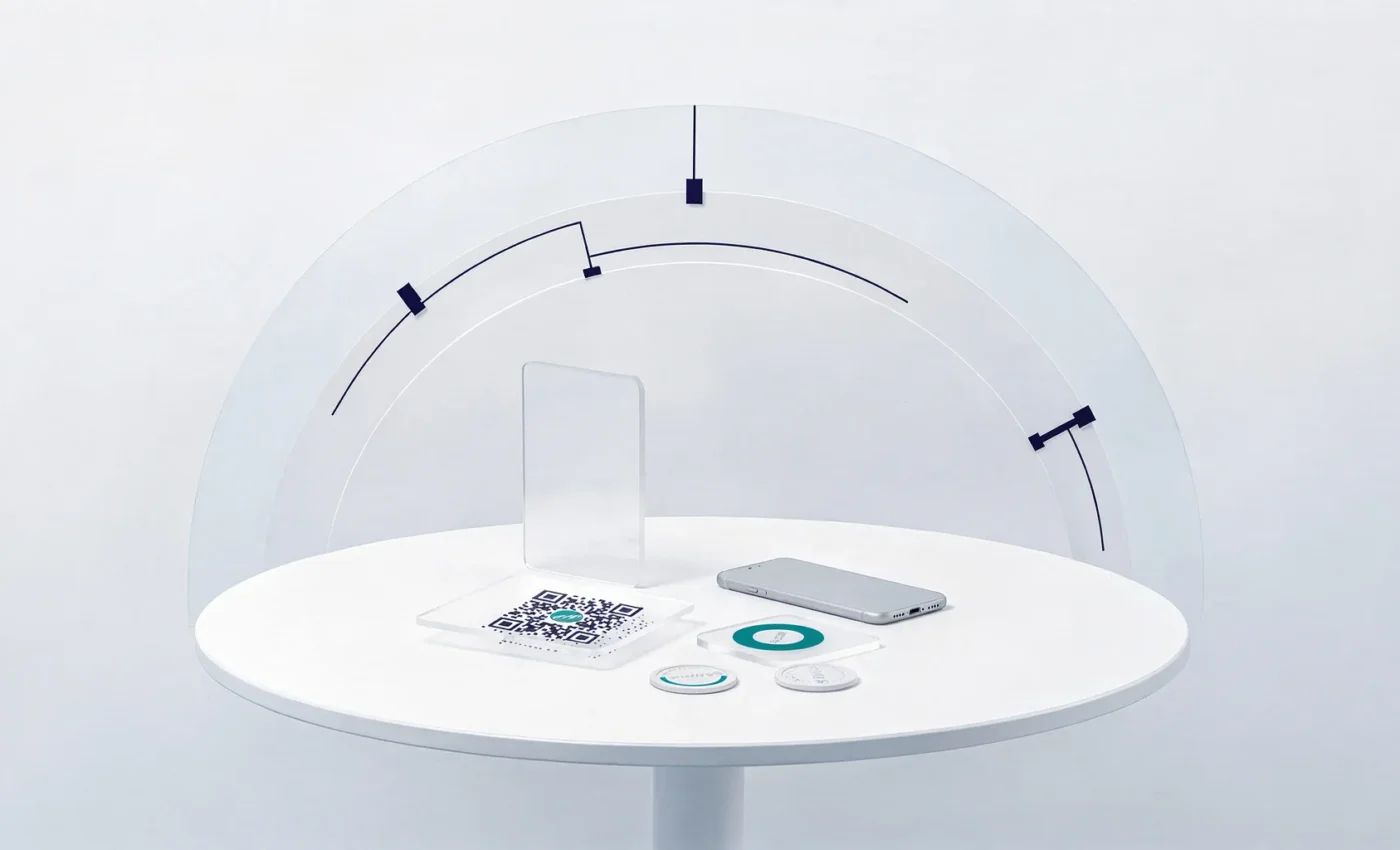
Moroccan restaurants are being pushed in two directions at once. Delivery platforms bring discovery but keep a firm grip on the customer relationship, while rising labour and ingredient costs make slow table service harder to absorb. The software needed to respond does not have to arrive as a single, expensive enterprise contract. A QR menu, a table-ordering layer, a payment link, a modest point-of-sale connection and a WhatsApp workflow can be assembled in stages, with each layer justified by a measurable operational or sales gain.
This analysis maps that lightweight stack, the evidence behind it and the operational limits Moroccan operators should respect before committing budget ahead of 2027.
Key Takeaways
- Morocco’s food e-commerce market was estimated at US$22 million in 2025, growing roughly 15–20% year on year, according to ECDB. The figure covers food e-commerce broadly, not restaurant ordering alone.
- QR menus are inexpensive, but they become a sales asset only when they support ordering, consent-based data capture and payment.
- Digital payment must sit alongside cash: access to online payment methods remains uneven across the population.
- Automation should start with bounded tasks — FAQs, order status, reservations — while staff keep control of refunds, complaints and allergy questions.
- The realistic sequence is information, then transactions, then retention, then selective automation.
Why a modular stack beats a single platform
Morocco’s online food delivery market is expanding as consumers seek convenience and restaurants adopt digital ordering channels. Market research on the segment identifies Glovo, Jumia Food and Yassir among the competing platforms, while noting that limited access to online payment methods still constrains part of the population.
Platform delivery buys reach. It rarely hands over the customer relationship: commissions, data restrictions and dependence on ranking algorithms stay with the platform. A direct channel — the restaurant’s own menu, order flow and contact list — gives control over promotions and repeat purchases, but it also transfers the work of generating traffic and supporting customers to the restaurant.
That trade-off is the argument for modularity. Each layer can be added, measured and kept or dropped on its own evidence, rather than betting the operating budget on one vendor’s promise of an all-in-one system.
Layer one: the QR menu as a data product
A QR code on each table, receipt, window or social-media profile should open a mobile-first menu. The essentials are Arabic, French and English content where relevant; prices, photos, ingredients and allergen information; availability controls for sold-out items; clear modifiers such as size, toppings and cooking preferences; and a printed fallback if connectivity or a customer’s device fails.
On its own, a QR menu is cheap and operationally simple, but it does not automatically create measurable revenue. Its value rises when the same code supports ordering, consent and payment rather than merely replacing paper. Moroccan-focused products such as Tablati and Tableat are presented as combining QR menus with table ordering, payments and analytics, with multilingual support positioned as a differentiator.
Layer two: table ordering and kitchen routing
The next layer lets a customer submit an order from the table. The hard part is not the customer interface but the routing: orders should land on a kitchen display, a printer or the existing point of sale so that no employee retypes them. Done properly, this reduces order-entry errors and frees staff during peak periods.
A pilot should begin with one service area or a limited menu, and test whether orders reach the correct station, how kitchen staff handle modifications, whether customers can edit or cancel, how table numbers and split bills are managed, and what happens when Wi-Fi, payment or the POS connection fails.
Automation vendors serving Morocco advertise integrations with restaurant systems such as Clyo, Micros and Lightspeed, according to Helloworld Agency. Compatibility, implementation costs and local support should be verified before purchase, not assumed from a feature list.
Layer three: payments that fit mixed behaviour
Digital payment should be layered onto the cash workflow, not forced over it. Useful options include a payment link sent after ordering, QR payment at the table, card payment through a Moroccan provider, cash confirmation for customers who do not pay digitally, and deposits for reservations or large orders.
UPay, for example, promotes QR bill payment at participating restaurants and combines payments with loyalty points and offers. Other vendors describe integrations with CMI and Stripe, including payment links generated through WhatsApp.
Entrepreneurs should compare transaction fees, settlement timing, refunds, chargebacks, card coverage, tax documentation and support before signing. A provider’s marketing claim does not establish that every card, wallet or restaurant terminal is supported. The broader shift in Moroccan digital payments is real, but adoption inside a single restaurant still depends on staff training and a fallback when a transaction fails.
From anonymous visits to first-party data
The stack becomes strategically valuable when it converts anonymous visits into permission-based data. Restaurants should track menu scans by location and time, item popularity, add-to-cart and checkout completion, average order value, payment success and failure rates, repeat visits and orders, promotion redemption, preparation times, and complaints or refunds.
None of this requires a complex customer relationship management system at the start. A consent-based phone number or WhatsApp opt-in linked to order history may be enough to send a receipt, request feedback or promote a relevant offer. What matters is discipline: disclose why contact details are collected, avoid adding customers to marketing lists without permission, restrict staff access and establish deletion procedures. AI features add a further question — how customer messages, order histories and personal data are stored and processed.
WhatsApp and bounded automation
WhatsApp can act as the bridge between digital and human service. A basic workflow can answer opening-hours questions, display the menu, collect takeaway orders, confirm delivery details and hand complex cases to staff. Moroccan automation providers advertise conversational ordering, reservations, dynamic menus and upselling through WhatsApp, QR codes and delivery channels, according to Botsfabrik.
Automation should begin with bounded tasks: frequently asked questions, menu and availability lookup, order-status updates, reservation requests, address collection, reordering of known items, and human escalation for complaints, refunds and unusual requests.
AI should not independently invent prices, promise unavailable products, approve refunds or make allergy guarantees. Menu content must come from a controlled database, and every AI-generated recommendation should be tested in Arabic, French and Moroccan Darija where supported. Poor translations or a misunderstood dialect create service failures and reputational damage. The same logic applies to choosing a model in the first place, as Onyx’s guide to selecting an AI model for Moroccan startups sets out.
A four-phase deployment plan before 2027
Phase one: digitize information. Build the multilingual menu, QR codes, item database, allergen notes and basic analytics. Keep printed menus available.
Phase two: digitize transactions. Add table or takeaway ordering, payment links and kitchen routing. Run a two- to four-week pilot and compare service time, errors and average order value with the previous process.
Phase three: build retention. Introduce opt-in receipts, loyalty or reorder messages, segmented promotions and feedback surveys.
Phase four: automate selectively. Add WhatsApp or web automation for repetitive requests, while keeping human approval for exceptions, refunds and sensitive issues. Confirmation workflows matter here: Onyx has documented how WhatsApp can reduce cash-on-delivery cancellations, a problem that also affects restaurants running their own delivery.
Limits, risks and what to watch
Third-party delivery platforms provide reach but may impose commissions, customer-data restrictions and dependence on platform algorithms. Direct ordering improves ownership of the customer relationship but requires the restaurant to generate traffic, manage support and coordinate delivery.
QR systems depend on smartphones, connectivity, clean codes, accessible design and staff training. A code that leads to a slow, untranslated or outdated menu damages trust more than a paper menu ever would. Payment adoption will remain uneven, so cash and assisted ordering should stay available.
The strongest pre-2027 strategy is not “replace staff with AI.” It is to remove repetitive entry work, reduce ordering friction, make payment easier and create reliable data for decisions. A small Moroccan restaurant can start with a QR menu and a payment link, then add ordering, analytics and automation only when each layer demonstrates a measurable benefit. The questions worth watching are practical: settlement terms from payment providers, the real depth of POS integrations, dialect quality in automated conversations, and how customer data is stored once the first opt-ins arrive.



Discussion
Add your perspective.
A question, a different perspective or experience to share? Add to the conversation.